
Pop. 14,126
Emergency Electrician In Azle, TX
34.4% of homes here were built before 1980, so older panels and wiring are common.
Free Call · Answered 24/7 · Local Pros Near You
A breaker that keeps tripping is doing its job — it has found a fault or an overload and is cutting power before wiring overheats. The cause is one of a short list: an overloaded circuit, a short circuit, a ground fault, an arc fault, or a breaker that has worn out. Reset it once only. If it trips, leave it off and call: one free call connects you with a pro who can typically arrive in 30–60 minutes.
A circuit breaker is a guard, not a nuisance. It watches the current on its circuit and cuts power the moment that current runs past what the wiring can carry safely, or when current escapes where it should never go. Tripping is the guard working. A breaker that trips once after a storm or a big appliance start may be a one-off; a breaker that trips again and again is reporting a fault that is still there, and resetting it does not clear the fault — it only re-energises it.
Is This Happening Right Now?
One free call connects you with a local pro who can check it safely — day or night.
Call (800) 555-0100A pro works from the cheap and likely towards the hidden and serious, because each step rules out a whole group of causes. First comes the load: what is actually running on the circuit, added up appliance by appliance. Second, the pattern: does it trip instantly on reset, after minutes under load, or at random? Third, the breaker itself, swapped or tested against a known-good one. Only then does the search move into the wiring.
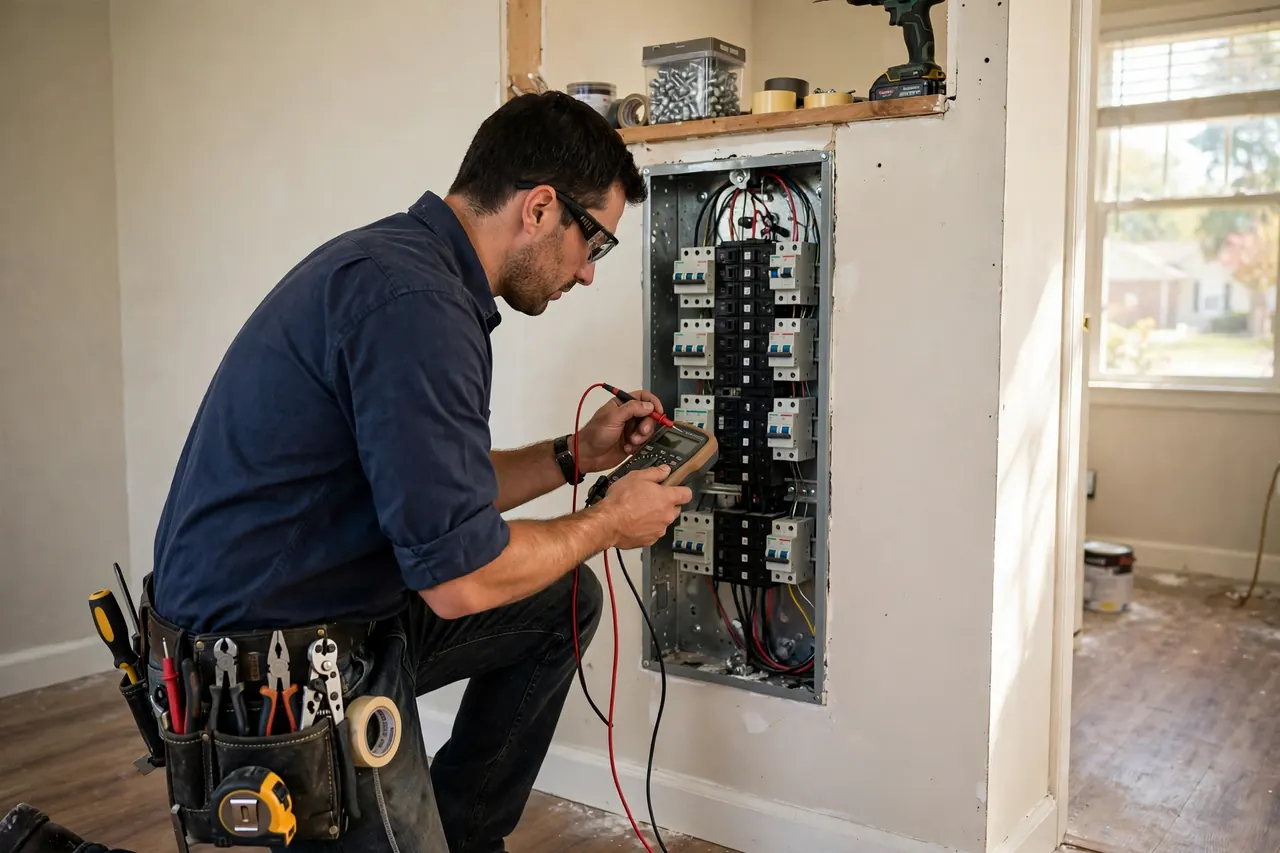
Instrument work follows the pattern. A clamp meter reads the real current draw under load; circuit tracing / fault finding maps what the circuit actually feeds, which is often more than the panel label claims; an insulation resistance tester (megohmmeter) finds damaged insulation leaking current where no eye can see. Safe isolation / de-energising comes before any cover comes off, and findings are checked against the National Electrical Code (NEC / NFPA 70).
Yes — overload is the most common cause, and the easiest to prove. An overloaded circuit is one asked to carry more than it was sized for: a space heater load and a kettle on the same kitchen run, a dryer and an iron sharing a laundry circuit, an EV charger circuit that was added to a panel with no spare capacity. The fix is to move load, or give the heavy appliance a dedicated circuit of its own — not a bigger breaker, which would let the wiring carry current it cannot shed as heat.
Instant tripping points to a hard fault: a short circuit, where a live conductor touches a neutral or ground, or a ground fault, where current leaks to earth through a damaged appliance or wet wiring. A GFCI (ground-fault circuit interrupter) device tripping instantly is reporting exactly that leak. Do not keep resetting into an instant trip — each reset feeds full fault current into the damage point. The pro isolates the circuit section by section, checking junction box connections and any rodent-damaged wiring, until the faulted stretch is found.
Random tripping usually means heat or arcing rather than overload. A loose connection warms and cools with the load, tripping the breaker thermally at odd moments; a failing breaker weakens the same way, and its clip can overheat against the bus bar. An AFCI (arc-fault circuit interrupter) device that trips at random is often reporting a real arc — a backstabbed connection working loose or wire insulation chafing inside a box. Thermal imaging / infrared scan finds these hot points under load without opening every box.
Yes. A circuit breaker is a mechanical device with springs, contacts and a thermal element, and all of them age. A breaker that has tripped many times, or sat in a hot panel for decades, can start tripping below its rating — nuisance trips on a load it once carried easily. The test is substitution or measurement: if the measured draw is well within rating and the breaker still trips, the breaker itself is the fault, and swapping it is the fix.
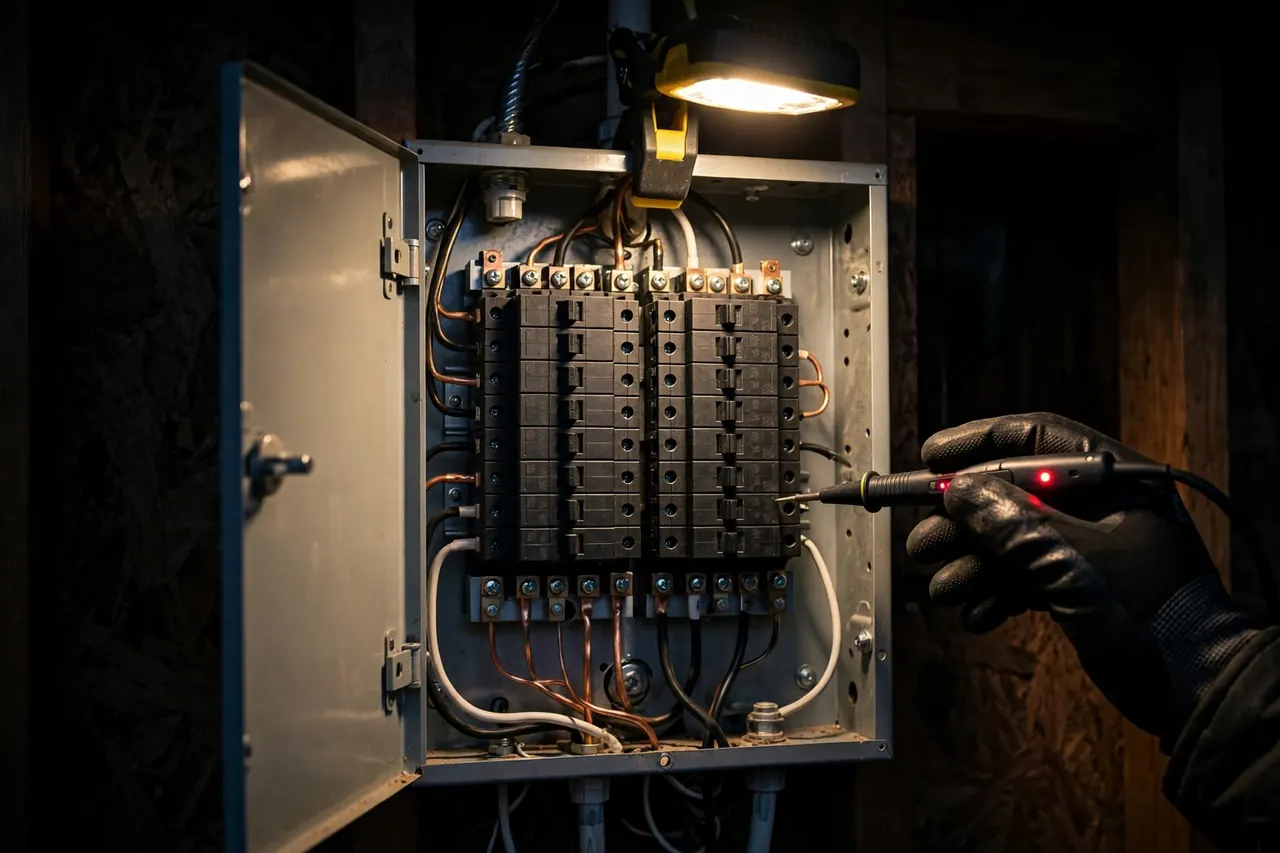
Reset it once. If it trips again, the breaker has answered the question: something on that circuit is wrong, and every further reset pushes fault current through it again. Repeated resetting can weld a worn breaker's contacts, overheat a loose connection into an arc, and turn a repairable fault into damaged wiring. Leave it off, unplug what the circuit feeds, and treat a breaker that will not hold on an empty circuit as a panel-side problem — the electrical panel / breaker panel itself needs testing, including torqueing panel connections to specification.
The honest answer is the factors, because the cause decides the job. A failed breaker is a small, quick repair; an overloaded circuit may need load moved or a new dedicated run; a short hidden in a wall costs more to find and reach than one in an accessible junction box. Load testing and tracing time, access to the damaged stretch, whether water intrusion or storm damage has hurt other parts, and whether the local building / permit department requires a permit for the repair all shape the final figure.
Call the same day if the breaker trips with a burning smell, buzzing, heat at the panel, or lights dimming across the home — and call 911 first if there is smoke or flame. Otherwise it is still not a wait-and-see fault: one free call connects you with an independent local pro who can typically arrive in 30–60 minutes, backed by 20+ Years Of Experience. That holds if you need an emergency electrician in Acampo. It also holds if you need an emergency electrician in Acton. An emergency electrician in Adelanto is covered the same way. So is an emergency electrician in Agoura Hills. The state page for an emergency electrician in California explains how cover works in that state. The state page for an emergency electrician in Florida explains it for its state too.
This guide applies everywhere we serve. These city pages show local facts, reviews and coverage:
34.4% of homes here were built before 1980, so older panels and wiring are common.
5.6% of homes here were built before 1980, so older panels and wiring are common.
34.6% of homes here were built before 1980, so older panels and wiring are common.
Still not sure what is happening at your home? Call and describe it. A real person answers, day or night, and the call is free.
Reviewed By Hamza
Master Electrician & Emergency Power Restoration Specialist
Hamza is a master electrician and emergency power restoration specialist with extensive field experience resolving critical residential and commercial electrical hazards across California, Florida, and Texas. He specializes in thermal arc-fault diagnostics, emergency panel replacements, storm-damaged service mast repairs, and whole-home surge mitigation to protect properties from electrical fires and extended outages.
Updated October 30, 2026
If your power problem cannot wait, one free call connects you with a local pro — 24/7.
Call (800) 555-0100Free call · Open now · 24 hours a day, 7 days a week
A plain-English emergency guide: what it means, how urgent it is, and what a pro checks first.
7 Min Read · Updated October 30, 2026
A plain-English emergency guide: what it means, how urgent it is, and what a pro checks first.
7 Min Read
A plain-English emergency guide: what it means, how urgent it is, and what a pro checks first.
7 Min Read